Introduction
In 1958, Edward Dmytryk’s adaptation of Irwin Shaw’s novel The Young Lions arrived at a moment when Hollywood was rethinking how to depict war. Moving beyond simplistic heroics, filmmakers pursued psychological truth and moral complexity. At the center of that effort stood Marlon Brando, whose method-driven approach transformed the German officer Christian Diestl into a layered, uncomfortable mirror of wartime humanity.
Historical and Cultural Context
The postwar era prompted artists to question received narratives. The Young Lions aimed to humanize individuals on both sides of the conflict without exculpating atrocities. Filming on location in Europe added authenticity, while the film’s structure—tracking multiple protagonists—encouraged viewers to consider the messy ethics of allegiance, obedience, and survival.
Brando’s Preparation and Method
Brando’s approach to Christian Diestl exemplified the actor’s commitment to depth. He treated the role as more than a costume, exploring the social, military, and psychological forces that shaped a young Wehrmacht officer. His preparation included:

- Study of military bearing: salutes, posture, and the small physical habits that signal training.
- Research into period detail: uniforms, equipment handling, and the visual codes of rank.
- Contextual study: reading about German society in the 1930s and early 1940s to understand indoctrination and duty.
- Interior work: developing Diestl’s moral interior—conflict between loyalty, fear, and emerging doubt.
These elements combined into a performance that prioritized internal conflict over caricature. Brando’s decisions were subtle, often visible in a glance or the way he held a rifle, transforming gesture into moral information for the viewer.
Performance Analysis
Christian Diestl is a study in contrasts: outwardly disciplined, inwardly unsettled. Brando built the role around controlled physicality—measured steps, clipped speech, a soldier’s readiness—while allowing fissures to appear at crucial moments. The result is a character who can be read as both product and victim of a violent ideology.
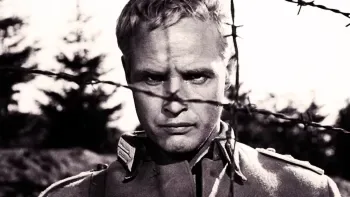
Rather than inviting sympathy through apology, Brando’s portrayal asks audiences to reckon with ambiguity. Viewers confront the uncomfortable idea that ordinary people can participate in horrific systems while simultaneously being constrained by those same systems. This moral disequilibrium is the film’s core dramatic engine.
Production: Locations, Direction, and Ensemble
Filming in France and Germany lent the picture a texture that studio backlots could not achieve. Scars of war, rebuilt villages, and European landscapes gave the film an immediacy that amplified its themes. Dmytryk, experienced in balancing large-scale sequences with intimate character moments, orchestrated scenes to preserve human complexity amid action.

The ensemble cast allowed cross-cutting perspectives: Montgomery Clift’s vulnerable, inward American soldier; Dean Martin’s brash, sometimes brittle persona; and Brando’s introspective German officer. Their interactions map wartime experience across nationality, temperament, and moral response.
Brando’s transformation was not only external: it used costume and posture as gateways to a complicated inner life.
Why the Performance Matters
Brando’s work in The Young Lions demonstrates how acting can be a mode of historical inquiry. He did not reduce Diestl to villainy or victimhood but tried to render a human being living inside an unforgiving system. That choice challenges audiences to think beyond binaries and to consider how ordinary choices, institutional pressures, and cultural narratives shape behavior.
Legacy and Continuing Relevance
More than six decades on, Brando’s portrayal endures as an example of transformative acting married to moral seriousness. The film invites contemporary viewers to reflect on the ethics of representation: how cinema depicts perpetrators, bystanders, and the conditions that enable violence. Brando’s stern visage in Wehrmacht attire has come to symbolize the actor’s craft—his willingness to enter difficult territory to illuminate human complexity.
Takeaways for Actors and Viewers
- Preparation matters: physical details and contextual study deepen performance.
- Ambiguity can be ethically productive: portraying complexity forces audience reflection.
- Location and direction shape authenticity: setting and creative leadership amplify thematic goals.
Conclusion
The Young Lions remains a noteworthy attempt to reconcile cinematic storytelling with moral nuance. Marlon Brando’s Christian Diestl is a key reason the film still resonates: a disciplined, meticulously crafted performance that refuses easy judgment. It underlines a central truth about great acting—true transformation requires empathy, research, and the courage to portray the full, unsettling spectrum of human behavior.